As-built Surveys are an essential part of the construction process. They provide detailed and accurate information about the final dimensions, materials, and locations of structures and roadways. This information is vital for the operation and maintenance of public infrastructure, specifically for legal and safety purposes. Conducted after the completion of a construction project, as-built surveys provide a record of the actual state of the project, allowing for the identification of deviations from original design plans.
As-built surveys play a critical role in ensuring the success of any construction project by providing a detailed record of the finished structures and helping architects, engineers, and other stakeholders accurately operate, and maintain infrastructure as well as in the design of future maintenance and upgrading projects. Increasingly As-Built surveys are a required by municipalities as part of public-works projects and private enterprise has followed suit.
At its simplest, an as-built survey is a detailed map or drawing of a building, property, roadway or utility network showing its exact locations, elevations, and surface features. This can include things like the location of catch basins, manholes, water and gas valves and other elements, as well as the location and size of utilities like plumbing and electrical systems. As-built surveys are typically created by a team of surveyors who use specialized equipment like total stations and 3D laser scanners to measure and document the area being surveyed.
So why are As-Built Surveys important?
For one thing, they provide a valuable reference record of an area, in both micro and macro levels. All the way from a localized single structure up to an entire roadway and corresponding utility network. This can be useful for things like maintenance and repairs, as it allows the owner or operator to know exactly where everything is located and how it is connected. As-built surveys can also be referenced for future renovations or expansions, allowing contractors and architects to see how the existing structures are built.
Another benefit of as-built surveys is that they can help to reduce costly and time-consuming errors and disputes during the construction process. By providing a detailed and accurate record of the finished structure, as-built surveys ensure that everyone involved in the project is on the same page.
In addition to these practical benefits, as-built surveys can also help to improve the overall quality of a structure. A detailed record of finished structures provided by as-built surveys help to identify any errors or deficiencies that may have gone unnoticed during the construction process; allowing the owner or operator to address these issues before they become major problems.
Utilizing as-built surveying will lead to higher-quality and more reliable structures by providing a detailed and accurate record of the finished structure. As-built surveys help to ensure the success of your project and the longevity of the structure.
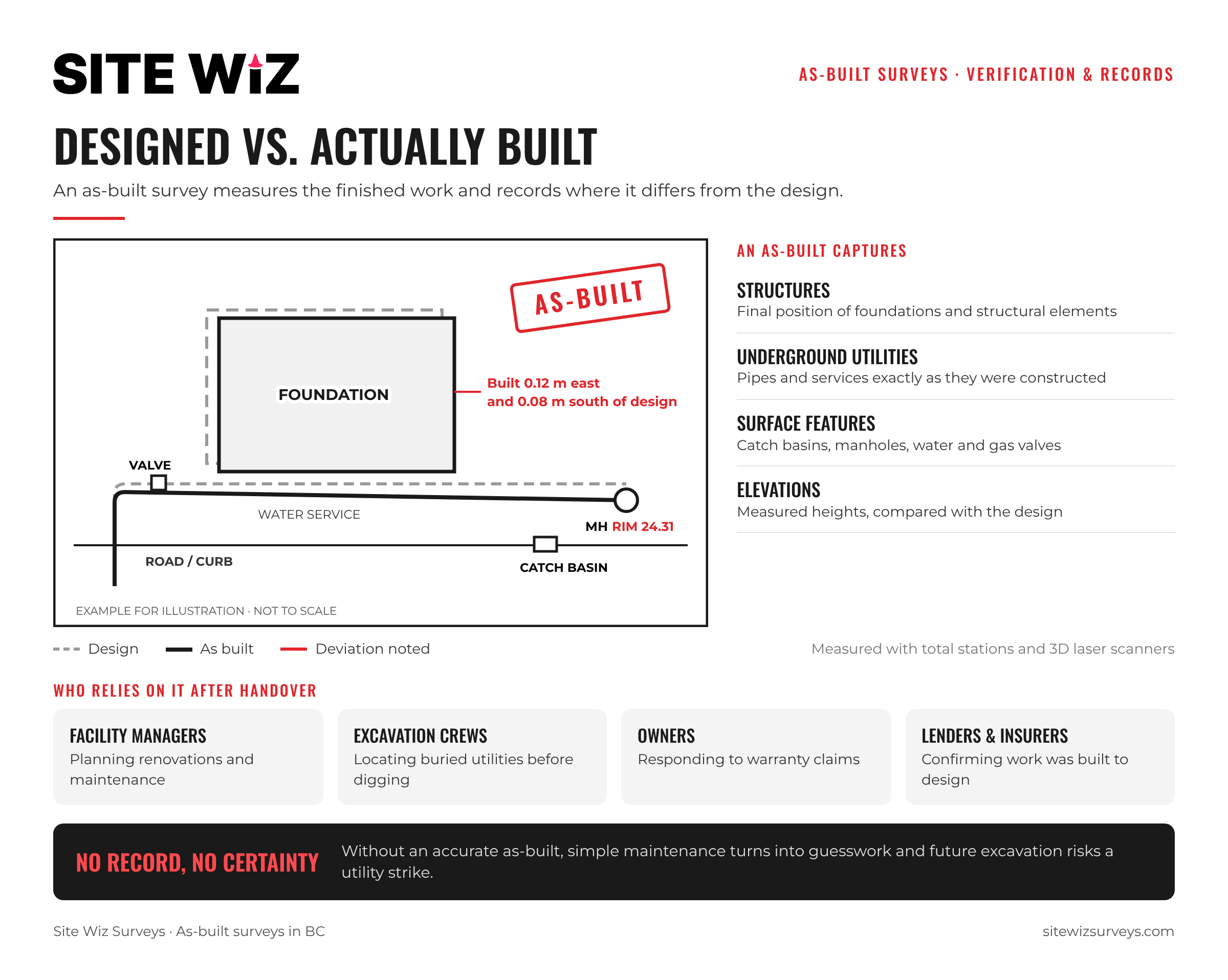
What Goes Into a Reliable As-Built Survey
A thorough as-built survey captures far more than a simple photo record. Field crews measure the final position of foundations, structural elements, and underground utilities exactly as they were constructed, then compare those measurements against the original design drawings. Any deviation, whether it’s a pipe run that shifted a few centimetres or a foundation that was adjusted in the field, gets documented so the record reflects reality rather than the original plan. This process typically combines GNSS positioning, total station measurements, and increasingly laser scanning for complex mechanical or structural elements, giving project owners a dataset they can trust for years after the crews have left the site.
Why As-Builts Matter Long After Construction Ends
The value of an as-built survey doesn’t end at project handover. Facility managers rely on these records when planning renovations, locating buried utilities before excavation, or responding to warranty claims. Lenders and insurers often request as-built documentation to confirm that a structure was completed according to code and design intent. Without an accurate record, even simple maintenance work can turn into costly guesswork, and utility strikes during future excavation become a real risk. For a deeper look at how these records are produced and used across British Columbia projects, see our guide to as-built record drawings in BC.
Verify Your Project with Precision.
As-built surveying is a critical service that we offer at Site Wiz Technical Services to support the success of our clients. By performing an as-built survey, we help construction companies maintain high standards of quality and provide them with a detailed and accurate record of completed structures. This information is essential for ensuring the longevity of the structure and can help our clients avoid costly rework or repairs in the future.
Get in touch!